Saturday, April 14, 2007


Golden Retriever

Golden Retriever

Origin

It is believed that the origin of this breed is related with the effort of a English lord, Lord Tweedmouth 1835, to select a docile dog, easy to teach and that retrieved his hunted peaces with damaging them.

Characteristics

This docile medium dog has for main characteristic the tenderness and friendship witch deals with people. In fact this can even been a down side, since they are dogs that don’t sea any evil and therefore lousy guards, since they trust anyone.

Can be placed in a yard, but prefers to be with his owners, as part of a family member. His docile, attempt and adapt component made then perfect adapt to the owners disposition and ideal companions for children.

His big down side is the need to retrieve any object and the paixon to gnaw anything that is in his reach.

Easy to teach and please, made them one of the favourites for jobs for dogs.

They need daily attention to make them happy, where can be included the task to brush them, since they have long hear.


Consideration

SIZE: The ideal size is 56-61 cm for males and 51-56 cm for females.

COR: Any ton between crem and gold.

Coat: Texture and size medium.

Other references

http://www.thegoldenretrieverclub.co.uk/


The Golden Retriever Club


Other articles:


Wednesday, September 06, 2006


Aussie - Australian Shepherd

australian shepherd blue merle
Origin

The origin of this breed as generate a lot of discussion and controversial, but what is settled is it's recognition came from America.
It is believe that the Aussie origin were the shepherd dogs that settled brought to the New World, were breading was made with the only goal to bring up it's working characteristics, shepherd, guard and fast thinking.

australian shepherd tri-red

The main impellor to the recognition of this dogs was an actor/trainer, Jay Sisler, of shows that use Aussies, or Blue Dogs as were the now, as show partners.

Only in 18 of April pf 1991, Australian Shepherd was recognized as a bread by American Kennel Club.

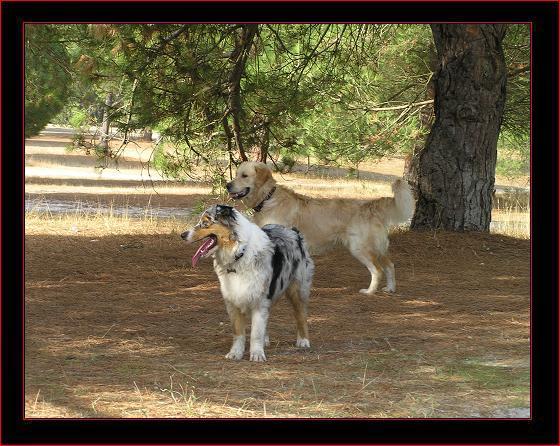
Australian Shepherd and Golden RetrieverCharacteristics

Aussie is a owner devoted dog that needs training, attention and contact with people.
It isn't a dog to put aside in the yard !

It is a dog that follows the owner through every room and loves to lay down at his feet. This characteristic may be rewarding, since we are never alone, and we have always some one near us, but can also be disturbing, since implies too have a shadow that needs attention and even follow us to the WC.

Dew to his strong working genetic component, this breed needs exercise, attention and training. If that isn't done or even not follow every day, the Aussies may became destructive or imagine form of escape or other ways to reach what he wants.

They are atletic, curiose dogs, great for physical activities, like agility, frisbee, flyball ...


australian shepherd red merle

Guard and alert for presence of strangers and even defend in case of invasion of their territory.

Don't adapt well to sedentary life and only tolerate a residence in a apartment if follow by a dedicated owner that is ready for physical activities.

Their quick thinking many times overcomes the owner.

Has many hear and is a moderate shaver that requires regular brushing.

australian shepherd blue merle

Consideration

SIZE: The ideal size is 51-58 cm for males and 46-54 cm for females.

COR: Blue-merle, Red-merle, black, and red his colors, with or without white spots and/or cobber spots. The white collar must not go below the cernelha. The white is tolerated in the neck (partial or forming a complete collar), in chest, legs, lower face, straps in head, and may go lower part until reaches 10 cm measure horizontally by elbow. The head white must not dominate the eyes that must be surrounded by colorful areas. The Merles, characteristically become darker with age.

Coat: Texture and size medium.

Other references

American Kennel Club

http://www.akc.org/breeds/australian_shepherd/index.cfm

Australian Shepherd Club of America

http://www.asca.org/

Is an Australian Shepherd the Right Dog for You?By Liz Palika

http://www.lizpalika.com/rightdog.html


Books about the breed:

The Australian Shepherd: Champion of Versatility
by Liz Palika (2003, Howell Book House).

All About Aussies: The Australian Shepherd from A to Z by Jeanne Joy Hartnagle-Taylor


Other articles:


Golden Retriever puppy
Choosing a puppy

Before choosing to have a puppy, a few considerations must be done:

1. Home

The home were the dog will leave is fundamental in choosing a dog. This doesn't mean to consider only the size or type of home (apartment, farm, …), but also if it is accessible or not to the dog.
For instance, the owner may have a big house, but if the dog only can access the yard, then it's home is the yard.
If the owner have a small apartment, but the dog only be there small periods of time, and in the remaining time is with the owner outside, as a companion in work and pleasure, them will be a dog that lives inside a house.

2. Availability

Dogs are essentially social animals that like to live in a group.
There are some races that tolerates better outside alone live, and other that needs company of people or other animal.
The owner availability time, has a big weight, since if he is absence a long period of time, will have to choose races that better adapts to this absence or to choose to have several dogs (sometimes cats and dogs also form family groups).

To live on a farm or yard doesn't mean that the owner doesn't spend time with the dog, since it is important the time spent for him to feel connected to the owner and part of a family.

3. Job

Dogs through time form partnerships with people, and were bread and trained to this jobs.
So we have breeds for pasturing, guard, hunt, company, ...
So some breeds don't leave well confined and without a job. For instance a Perdigueiro Português wouldn't be happy confined in a apartment.
This doesn't mean that isn't possible to have a kind of a breed, but means that training or some exercise, like agility, must considered.
The study and analysis of a bread must be done before buying that breed.

4. Maintenance

The maintenance of a healthy dog has some expensives that must be considered.

a) Feeding

Dogs should be fed with their on food and people left overs are not suitable for dogs.
The breeder or veterinarian are the best people to inform the owner about the food that should be given during the dog life.

b) Veterinarian

Every dog should be vaccine and desparitize annually.
Sickness and health problems, like in people, can also appear in a dog and some times this can be quite expensive.

c) Hygiene

Apartment dogs have more expenses, since is necessary to buy proper bags to collect droppings in the street or to traine the dog to use a place, like a sand box.
But farm or yard dogs also need cleaning of the dropping site, witch implies trash bags and cleaning with detergents.

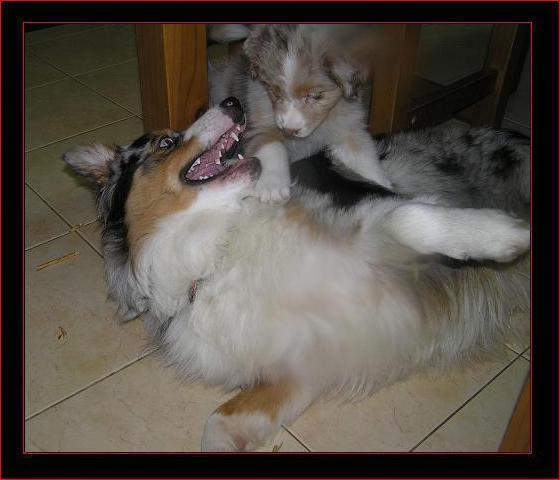
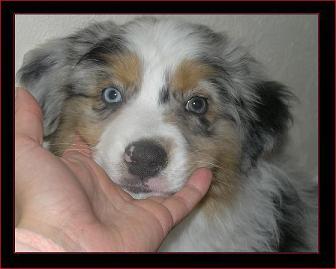
Australian Shepherd puppy
5. Training

Some breeds imply more work and dedication by the owner for their training and socialization with people and other animals.
All dogs should have basic training, that can be or not administrated by the owner.

6. Breeding

To breed a dog is not something light, since implies expensive health tests (like genetic diseases, dysphasia, eyes,… ); expensive with correct feeding of the mother and regular visits to the veterinarian to watch the pregnancy mother and after birth health; feeding and vaccination of the puppies; and the possibility of not having a proper owner or devolution of the puppy.
After all considerations, the choice of mother and father must be made with careful and analyses, in order to keep the race standards and have healthy puppies with good personalities.

Golden Retriever puppy


Other articles:


Tuesday, September 05, 2006

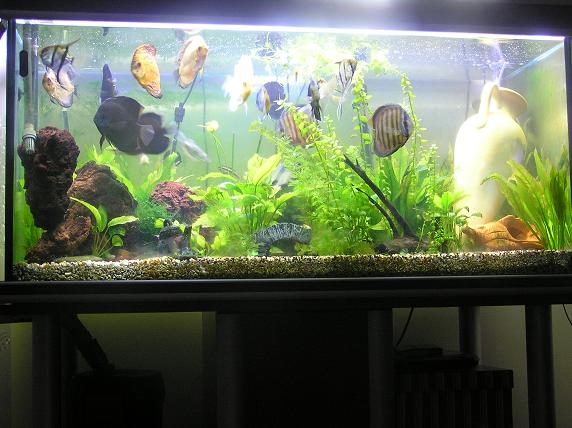
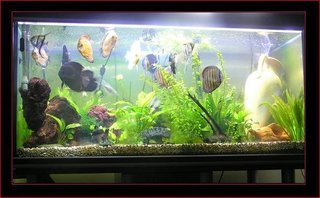
Steps to mount a sweet water aquarium

1. Ecosystem

Before mounting an aquarium we have to be awere what kind of fish we intend.
Every type of fish as his needs, specially concerning to the ecosystem and aquarium size.
There are fishes that leave in a habitat of rocks, others of send, or Amazon or even swamp. This fishes have to be also consider as aquarium companions or even what kind of plants to use.
After the habitant choice, we can go to the next step, equipment.

2. Equipment

The equipment is compose by 3 elements:

a) Thermostat

Basically is to keep the water temperature. This can change depending on the fish and plants kept, but normally should be kept about 28ºC.


Attention – Disconnect the electricity, before removing it from water

b) Filter

Basically is used to filter and oxigenate the aquarium water, and should be clean in a regular bases.

ou

Some filters work through resins, ceramic, coal and sponge. The sponge filter, must be changed when the sponge is dark with dirt. The coal must be changed 6 to 6 months.

c ) Light

Imitates sun light, and it’s intensity must match the needs of plants or fiches. Normally, 8 h period of exposure is enouph.


We can, depending of the needs equipment for CO2, that adds some feeding complement to the plants. Also a circulation pomp may add some oxygen to the water.

3. Substratum

Now that we chosen our aquarium and have the basic equipment, the substratum must be chosen, that is, what is going to be the bottom of the aquarium. There are several choices:
a) Coral gravel for alcaline ecosystem like Lake Malawi

b) Send for sendy river fishes

c) Fertilizer or plant base necessary for plants to grab on

d) River gravel, that can be thick, medium or skinny

4. Mounting

Finally mounting !

First all is washed with running water. The gravel must be well washed or the aquarim water won’t be clean.

Attention: Never use detergents or any other product that isn’t indicated for aquarium

After the aquarium is placed in the chosen place. Do not put near a window.
The gravel, filter, light, and thermostat are placed (only after full with water the equipment is turn on)

The aquarium should stay about 15 days only full of water and with the equipment working, were the temperature should be controlled. In this days the decoration, like rocks and other can be chosen.

5. Plants

After 15 days, with filters and temperature stabilized, it is time to add the first plants.

At this time the location, light and fertilizers must be considered.

Plants are leaving beans that have needs and should be respected.

http://www.tropica.com/default.asp

Between plants and fish, 3 days should be given for plants to recover for the transplantation.


6. Fish

Finally we arrive to fish.

Before choosing fish on the store, a few basic rules must be considered:

a) Companions and aquarium habitat
b) Fish characteristics like size
c) How many time is in the store (ideal should be 15 days)
d) Store aquarium, if it is clean and looks good
e) Fish skin and flippers.
f) Any sick companions or with bad look
g) Store water characteristics

After buying we have to be careful to fish introduction, since a choque can cause his death.
So, leave the fish in the bag inside of the aquarium at least 5 m, so he accustoms to the temperature. After that time add some aquarium water to the bag and wait another 5 m.
Now we can let them free. Do not add the store water to your aquarium !
In the first day it is normal that the fish doesn’t eat hides. This should respected, since the huge stress can cause sickness and even kill the fish..

7. Feeding

Fish and plants need to be fed. To plants a fertilizer should be had 15 to 15 days and a weekly change 10% of water should be done.
Fish can be fed with flakes, frozen food or alive food. A mix of several foods should be given for a healthy fish.

8. Maintenance

Now that the ecosystem is mounted and working a few rules should be follow:
a) When we feed the fish, all the food should be eaten and no remains should be left on the aquarium bottom.
b) Check if the equipment is working properly
c) Watch the fish to see if there are any health problems.
d) Change 10% water every week
e) Drop fertilizer for the plants every 15 days
f) See, if it is a sponge filter, needs to be changed or washed.
g) If it is a coal filter, change the coal after 6 months.

9. Sickness

Like us, fish also are subjected to sickness, and many times this is introduced with new fish or by our hands.
To detect an observation is the key. Changing flippers, lost of appetite, changing colors, changing on the skin, … are some symptoms that we can detect in our little friends.
Some times they can be treated, but not always this happens.


Livebearers


Description


Livebearers are fish that don’t lay eggs, but give birth to tiny live fish.

They are easy fish to breed and keep, because they are little demanding about the water conditions.

Usually they only need a well-planted aquarium, temperature about 25º-28º, a balanced diet and weekly partial (10%) water changed, to keep this fish healthy and during a long time.

The great attractive about this kind of fish is it’s coloration (yellow, blue, red, orange, white, black, …) and easiness to breed.


Feeding


They are not demanding fish, but we must take care to offer then a balanced diet.

The diet may consist in dry food, flakes, baby brine, Microworms, Daphnia, Grindal Worms.


Breeding


Livebearers are fish easy to breed and normally its only necessary to have a male and several females, for us to have young fish swimming around.
But dew to the easiness of breeding, the parents don’t have any parent care in relation to their fry, thus is necessary to have some care in order to have some survivors.


There is, mainly, two methods to increase the rate of fry survival:
1ª) Maternities: Consists in setting a fish support (it is very common in any pet shop), where the female is placed until delivery.
Personally, we do not have a good opinion on this method, because a great percentage of the times, the females leave themselves to die or give birth before delivery time, which is a consequence of the stress being confined to a place smaller and different of they environment.

2ª) Hiding places: Consists in a very planted aquarium with rocks and other decoration that allows the fry to hide.
This method is mainly used, not only for supplying more natural and free stress environment, but because it seems to reduce the mortality of the mothers. In other end, we have a considerable reduction of fry survival.


The livebearers females are easily to distinct from the males, due to their large bellies (mainly when they are pregnant) and when they are ready to deliver, a dark spot can be seen in the end of the belly, witch is the eyes of the babies.


Desieses


Poor water conditions are the main reason for fish stress and therefore for the creation of ideal conditions for the beginning of desieses.


Follows below a brief description of some livebearers illnesses:

Columnaris (Mouth fungus)

Symptom: Whit fungus around the mouth, that sometimes, may appear in the body and fish fin.

Treatment: Usually is caused bay fish stress and poor water conditions. For treatment use anti-bacterial medicines.


Wasting Disease

Symptom: Shrinking of the belly, loss of weight, lost of vitality and shrunk fins.

Treatment: Flagyl or internal remover of parasites.


Ictio

Symptom: Small white spots that provoke tingle.

Treatment: Raise water temperature and use anti-fungus medicines. It exists in the market medicines that relate the treatment against this illness.


Velvet

Symptom: Tingle, lethargy, appetite loss and weight, gasping breath, fins leaned against the body and white or yellowish velvet in the skin.

Treatment: Raise temperature of the aquarium, reduce illumination and use copper sulphate. It exists in the market medicines that relate the treatment against this illness.